
For Rachel Marlow (BME Instrumental Education ’07), the past few months have been a crescendo of activity.
Usually, a music teacher’s schedule follows the steady rhythm of school bells and seasonal concerts. But since being named the 2026 , Marlow’s calendar has picked up a new, frantic tempo.
“Starting in November, I feel like I’ve had a show every week for different levels,” Marlow laughs, noting that she shifted some of her spring performances back to the fall to accommodate her new statewide travel schedule. “Secretly, I’m kind of an introvert. I’m the person who loves to put on shows, but I want to be behind the scenes making the magic happen. Now, I’m on the front of the stage.”
Brandi Leggett, principal of Central Elementary School in Olathe, Kansas, where Marlow works, said the music teacher has become a bit of a local celebrity.
“Our school had a mini-indoor parade to celebrate her,” Leggett said. “Everyone was really proud. She is being recognized from the newspaper, news and on the cover of the Olathe Public Schools magazine.”
Marlow has handed her baton to a long-term substitute so she can travel the state. As an ambassador for education, she will visit universities and speak to the next generation of teachers — a journey that traces its roots back to her own pivotal days as a student at Ģ¹½TV.
The OCU audition that changed everything
Marlow describes herself as a “Midwest girl,” having bounced between Nebraska, Kansas and Oklahoma. A graduate of Jenks High School near Tulsa, she was already immersed in a robust music program when her private-lesson instructor suggested she audition for OCU.
She recalls walking into her audition, terrified and convinced she wasn’t ready.
“I remember walking in so nervous... and it was Dean (Mark) Parker and Dr. (Matthew) Mailman both in there,” Marlow says. “I did my audition, and they immediately made me feel so welcome.”
That moment set the tone for her undergraduate experience. Marlow, a horn principal who also dabbled in jazz band and voice, found a home in the rigorous yet supportive environment of the Wanda L. Bass School of Music.
Lessons in silence
While Marlow’s degree is in music education, her training at OCU went far beyond notes on a page. She vividly remembers a conducting class with Mailman that fundamentally changed her approach to teaching.
“One of the days in conducting class, he did an entire silent rehearsal. The whole class was silent,” she recalled. “I just remember being mesmerized. I was like, ‘How do you teach when you don't have words?’ But I fully understood what he was expecting.”
He doesn’t take credit for coming up with the idea, but Mailman noted that the technique was designed to sharpen non-verbal communication.
“If you have a professor that comes into a class and is teaching without talking, that really gets your attention,” Mailman said.
Decades later, the technique is still working — even with 5-year-olds. Principal Leggett has watched Marlow silence a rowdy kindergarten class without uttering a syllable.
“She used eye contact and calm movements to get everyone’s attention,” Leggett said. “The kids quieted down and followed her lead like clockwork. They were fascinated with her movements. It was impressive how much control she had just from her presence.”
Overcoming odds
Perhaps the most remarkable part of Marlow’s journey is that her musical ear could develop despite significant physical challenges. Between the ages of 2 and 10, Marlow underwent 15 major surgeries to reconstruct her inner ears due to severe infections. She suffers from conductive hearing loss and is a lip reader.
For her professors, her ability to overcome the obstacle was nothing short of a mystery.
“It was always remarkable to me that she had this profound hearing loss, yet she had just the most gorgeous horn sound,” said Kate Pritchett, OCU professor of horn. “I don't know if her previous teachers were responsible for that, or she just had an innate sense, but that was always a little bit of a mystery and kind of amazing.”
Pritchett highlights a specific recital performance of a technically difficult piece by French composer Eugene Bozza, intended as an exam piece for the Paris Conservatory.
“There’s one moment where it does all these leaps down into the low register, and I mentioned to her that there’s a recording of someone going even further, another octave lower,” Pritchett recalled. “And she did it. She embraced it.”
A modern mix for modern students
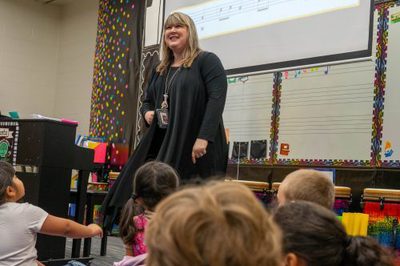
It is her personal history with hearing loss that drives Marlow’s passion for inclusivity. For her, music is a bridge for students who struggle with traditional communication.
“I’ve got kids who maybe can’t speak as well as their classmates, but they love to sing songs,” Marlow said. “So they’re not going to have a conversation with you, but if you sing a song that they know, they’ll sing it back to you.”
Rather than sticking with the standard elementary school music class tunes, Marlow introduces electronic music and popular video game scores her students find oh so familiar.
Marlow’s resume is unique. She spent several years teaching special education before returning to the music classroom. This cross-disciplinary experience allows her to collaborate closely with occupational therapists and speech pathologists.
Leggett notes that Marlow’s willingness to take risks sets her apart from “traditional” music teachers.
“Instead of sticking only to things like piano, recorder and printed sheet music, Rachel brings electronic music tools, apps and beat-making to connect with students’ musical lives,” Leggett said. “She lets students remix songs and blends popular genres with curriculum standards. This not only meets learning goals but also builds engagement.”
The approach yields results for students who might otherwise be overlooked. Leggett recalls one particularly quiet student who found their voice in Marlow’s room.
“In her music class, the student would have so much confidence,” Leggett recalled. “The student would dance and speak in performances in front of the entire school. This demonstrated how Rachel really finds ways to help students thrive.”
Uniting through sound
Marlow’s philosophy is rooted in the belief that music can unite individuals who might not otherwise connect.
“Through performing, you can create something far bigger than yourself,” Marlow said. “It’s making sure that music is for everyone.”
As she travels the state representing the profession, her former professors are watching with pride. Mailman calls her “completely deserving,” while Dr. Pritchett praises her “bubbly” determination.
For Leggett, Marlow’s impact can be summed up in a single sentence: “Rachel teaches music as a hands-on, modern, student-centered exploration where creativity and real-world tech meet clear routines so every student can participate and succeed.”
From the practice rooms of OCU to the Kansas Teacher of the Year road tour, Marlow is proving that with the right foundation, everyone can make magic happen.
